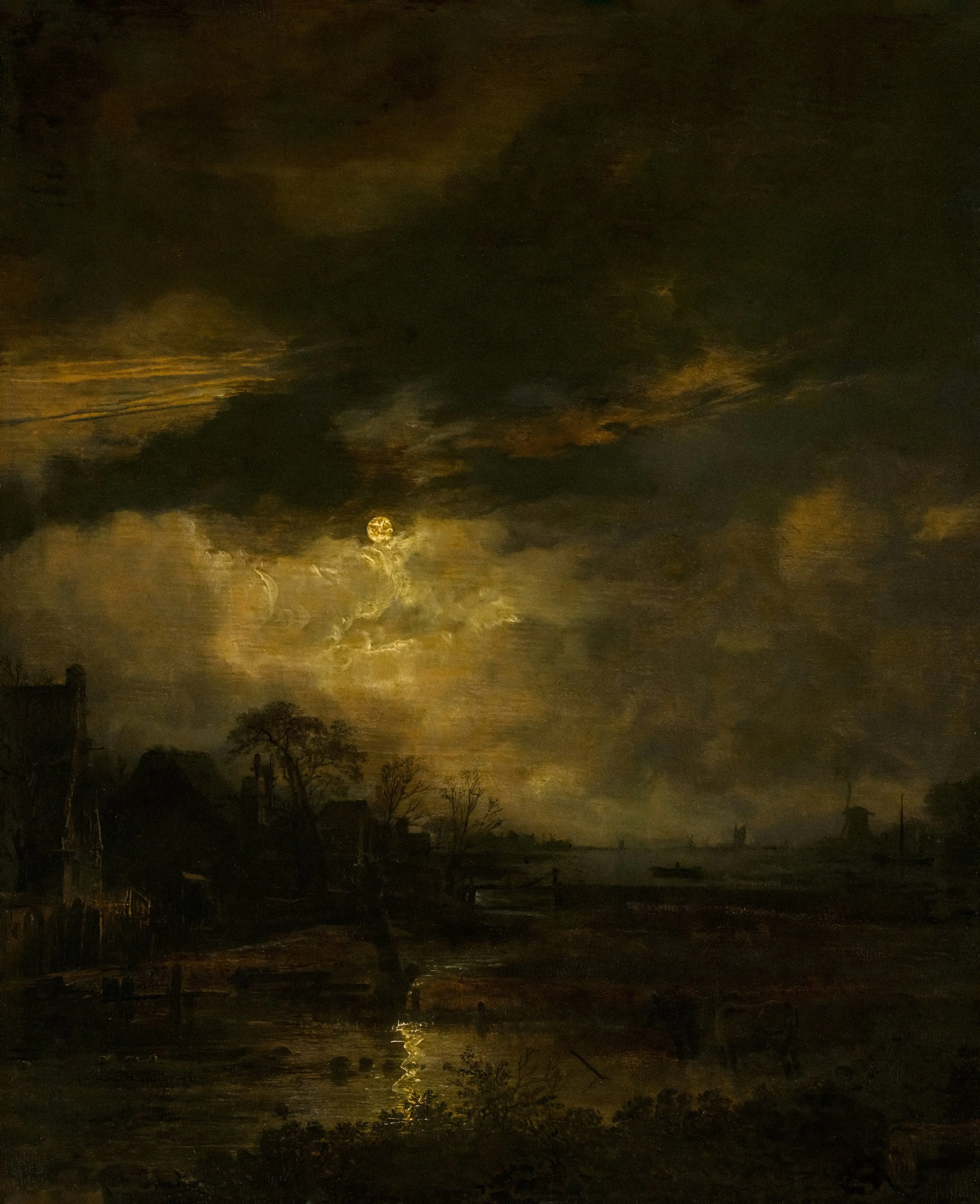
Godzilla or Jesus Christ?
A Conditional Essay on Lord Byron’s “Darkness”
Conditional
27 March 2025
Megan Poe
“I am so changeable, being everything by turns and nothing long – I am such a strange mélange of good and evil, that it would be difficult to describe me. There are two sentiments in which I am constant – a strong love of liberty, and a detestation of cant¹
– Lord Byron
If you wash your hair in your own dirty bathwater in the middle of the night,
If your father has ever shot his dog in the backyard because it wouldn’t stop biting the other,
If your religion is made from the blood of your mother’s sacrifice to bring you to this Earth,
If you’re disturbed by muscular crucifixes, nose bleeds, martyrdom, or solar eclipses,
If you’ve ever cracked a bone back into place, just to find it rolling somewhere else, perhaps out of your body, tomorrow on the floor –
If you’ve ever woken from a dream about being a piece of furniture under someone else’s foot,
Then you should read the Romantic poet Lord Byron’s “Darkness.”
82 lines of iambic pantameter, written sometime between Byron’s lustful and fleeting affair with his half-sister, and his debilitating infatuation with a fellow choir boy, “Darkness” is the apocalypse poem that gores the beauty of the sublime. In the crooked symphony of Coleridge and Wordsworth’s aeolian lyres and dulcimers, “Darkness” is a heavy metal thrash. War is described as a masculine entity who “gluts himself” alone, enemies die “of their mutual hideousness,” and Earth is “but one thought – and that [is] death / immediate and inglorious” There are no survivors of Byron’s brute fatalism prophesied in a dream “which is not all a dream.”
When you read “Darkness,” it feels like the poem is standing in the room with you. It’s in the corner, on two spindly legs with all and none of the floor between you. “Darkness” is Byron’s reach into the future – his straining intrusion tethered by timeless existential dread. The reader of the poem is not separate from the “Man” described within it, and is therefore ordained by Byron to situate themself somewhere between the “funeral piles” and the masterless Nature required to read it. This is as much a collapse of self as it is of the societal, the biological, the ontological and the spiritual world.
I first encountered “Darkness” in a British Romantic Literature class in college with a professor who terrified me. He was a no-nonsense cold-caller in a sweater vest who, within his first three years of professorship, already had the impatience of an old, waning tenure. He carried disappointment and contempt forwardly; very few students received good marks, and absence led to immediate failure. The reason I remember “Darkness” of all poems in this cowardly, frustrated semester, is simply because I received my only A of the class on my paper analyzing it. But not so simply, because there were all the reasons it mattered to write about in the first place. I don’t know how many times I’ll need to write about it to get “Darkness” outside of me.
Until Byron, I was unconvinced by the course material laden with godly nursery rhymes and pages about long, self-important walks in the forest. The Romantics’ obsession with nature felt eerily disingenuous. Byron similarly noted this in a journal, calling Wordsworth a “shabby cockney brat.” But, it was at least more palatable than all the literature glorifying Abrahamic dominion over the Earth. My Norton Anthology was marred by angry margin annotations and pleas for everyone to die. Finally, on page 614, I found a kindred soul.
Byron’s work made me feel like I was sitting in the back pew of a gothic ceremony – in the cold, away from the celebratory violence of ritual I’d been desensitized to. I was taken back to moments in Catholic Mass where I would strain to find where my soul was. I’d hold my breath and tense all my muscles, trying to identify some kind of cavity or a chasmic presence in my chest. When the priest would open the tabernacle, everyone would breathe or lean in like they were receiving something. Something that would fill up their chests. Instead, all I inhaled was the stale breath of the eucharistic bread beggars, in line and starving for Christ. The more I de-signified the ritual, the further I collapsed into an apocalypse of myself. I hadn’t felt anything as percussive and guttural as this until I read “Darkness” and realized I didn’t have to die off alone.
Melancholy, opinionated, independent, and bisexual, I found everything of Byron in myself except for his clubbed foot and incestual tendencies. He was ostracized from and accused of satanism by the traditional religious, yet defended the Church against discrimination in the campaign of Catholic emancipation in 1812. In one poem, “The Giaour”, he describes his own soul as a scorpion stinging itself to death to escape the burning tongues of scornful whispers surrounding the scandal of his nonbelief. The teenage angst inside me will always live venomously like this. Centuries before I’d been a thought, he’d been an active defiant against these dogmatic political structures. This inspired me. Not to rebel, but to carry that passionate expression wholeheartedly. To find that gored sublime in the possibility of a death brought equally to us all.
Which I think is the point.
During my period of reading Romantic poetry, it was winter and always dark. Lake Superior snarled and bit in its low, dormant age. I wished for nothing. Not for the winter to end, not for a reason to trim my fingernails. The perilous body of water out my front door was an old house with its creaks and moans; it was haunted and all-consuming under reincarnated ice from a 191-year retention cycle, or further yet, from ritualistic low-pressure systems pulling moisture out of the Gulf of Mexico for as long as there’s been weather as we know it. 208 years earlier, George Gordon Byron surveyed Lake Geneva, similarly frozen over, in a climactic disaster under identical darkness: “The Year Without a Summer” in Switzerland, after the eruption of Mount Tambora. His world was completely sunless and carpeted with ash from above. I can so vividly picture Byron sitting on a rock and writing the opening lines of what he saw before him:
The bright sun was extinguish'd, and the stars
Did wander darkling in the eternal space,
Rayless, and pathless, and the icy earth
Swung blind and blackening in the moonless air
Morn came and went—and came, and brought no day.
Darkness – that hatred, that “lump of death” is so easy to embrace and unify with your identity. I too wrote my cynicist poems looking over the frozen lake and let all purpose shrivel and expire in the necrotizing cold. But just like how heavy metal music is more than angered noise, this essay is not about a directed pessimism, and “Darkness” is not about blame. Doomful art holds a lot of merit in how it unites us through animal emotion and communal bonding over the horror of experience.
For a while, I found comfort in my rationalism hung over those who thought they were breathing in anything but air from the tabernacle. I was cautious of the cognitive dissonance required to believe that an unseen entity had true control over all beginnings and ends and not the brute fact of Nature itself – whose material our temples of worship are built from, or whose primordial knowledge will glean from our mistakes and will unprejudicedly starve us away if we are unfit for survival. I’ll make a claim that moral absolutism has nothing to do with survival, not that good morals are upheld in organized religion anyway.
For a while, saturated in climate anxiety, all I could think about was that the preachings about an unspoiled land waiting for us in a congealed and purposefully unfathomable realm were manipulation tactics at best, ungrateful and dismissive condemnation of our Earth at worst. Not to mention my frustration over the hierarchy of souls which determines the worthiness of compassion of other creatures based on how we may utilize or symbolize them. Surely Byron was just as angry as I was.
When there are only two living men remaining in “Darkness”, each man sits across the other from the “dying embers of an altar-place / where had been heap’d a mass of holy things for an unholy usage.” By this point in the poem, humanity has eaten itself up in diseased fits of cannibalism right after “vipers crawl'd / And twin'd themselves among the multitude, / Hissing, but stingless— [...] (and) slain for food.” This biblical allusion embodies how the morality or evil associated with a viper is placed by human conventions, but in actuality its venom is an amoral necessity for survival.
The irony for me lies in that the viper’s fear is what tames it. A reverse of power happens in their consumption, just as how the objects with associated reverence or prosperity are only useful so far as how brightly they burn. Byron is asking us to take the mysticism away and acknowledge the materiality of our destruction to discover the infinite source of Nature's creation. For a while, I found comfort in my rationalism hung over the religious, but Byron taught me to find comfort instead from my spirituality towards the inherent fragility and ephemerality of all life. His art born in the aftermath of The Enlightenment created a somber reverberation of another within mine. Human and Earth’s self-same imagination outlive the crushing limits of civilization.
—
For many in this age of climate crisis, the end is an unrelatable, distant creature bellowing somewhere blurry. At least for those in the global north. Something to be angry about, wallowing in your own individual helplessness in anticipatory suffering. But it is ever present for those whose homes are already underwater, for those with nowhere to put their own two feet. It would take a certain kind of immediacy to capture true desperation, true disgust with humanity for how out of place we are with the world. And that is what brought “Darkness” about in 1816.
Perhaps Byron was similarly frustrated with the industrial revolution² or Romantic droning of awe. Byron would not have anticipated fracking, pollutant sludge, or factory farming, nor would he have been aware of the inevitable history of our planet that encapsulates not just one but nine ice ages – a wipeout of life that is no one’s personal failure. But he was so saturated in his own moment of time there was only room for something truly enormous, truly leviathan, to end it.
The man who sat next to me in Romantic Literature wore a handkerchief around his neck and had an odd obsession with Godzilla. He would tell me every day how Godzilla could destroy everything if he wanted to. A true world-ender. That nothing on Earth, material or fictional, was more powerful. Each class, he’d ask me who would win: “Godzilla or King Kong?” “Godzilla or Frankenstein’s monster?” “Godzilla or Jesus Christ?” Godzilla. God is literally in the name. It was a fantastic question to begin a Romantic literature class with – which enormity should be feared the most? Whose monstrosity is the most poetic?
In January, he handed me a sticky note with a hand-scrawled news article link. He was sheepish but deliberate. Whatever the injustice was, he acted like he wanted me to do something about it. I typed in the URL one symbol at a time to find an interview with him in front of his smoldering mobile home. Something or someone had lit it on fire while he was sleeping. It was the second house fire within the mobile home community that week. He stood in front of it, perplexed by the mystery. Before the video cut, with a scorch blister on his chin, he said, “this is… a terrible moment.” The next class, he asked me what I thought, and I told him.
Considered some of the first cli-fi literature, Lord Byron describes an apocalypse caused not by darkness, but by the selfishness for light within it. Mount Tambora’s eruption was a natural fact of the environment, but the hideousness formed under its shadows is the true downfall of complex life. This reactionary response leaves every creature agentless against their own nature:
Men forgot their passions in the dread
Of this their desolation; and all hearts
Were chill'd into a selfish prayer for light:
The palaces of crowned kings—the huts,
The habitations of all things which dwell,
Were burnt for beacons; cities were consum'd,
And men were gather'd round their blazing homes
To look once more into each other's face.
Luckily that January there was no apocalypse but that made my classmate’s house fire all the more sinister. What I glean from these lines is that the brute violence that extinguishes the world is human hysteria. It is man’s inability to survive without sight. I think Byron would agree with me that humanity needs to have control, to have an ‘other’ to shine the flashlight on, asking it to explain itself. The irreligious 20-year-old in me, for four years, contended with what it meant for there to be no order. I did not have to look inward to find a sliver of god, but I did. I found it in the death of this dog:
The meagre by the meagre were devour'd,
Even dogs assail'd their masters, all save one,
And he was faithful to a corse³ and kept
The birds and beasts and famish'd men at bay,
Till hunger clung them, or the dropping dead
Lur'd their lank jaws; himself sought out no food,
But with a piteous and perpetual moan,
And a quick desolate cry, licking the hand
Which answer'd not with a caress—he died.
Talk about ravishing the sublime. Many Romantics gush about beauty in its abundance, but Byron finds beauty in its scarcity or absence. That is a kind of Nature to worship. The dog’s master isn’t the human, but its inherent nature of loyalty, just as ours is our proclivity to selfishness. And so, to a fault, the dog succumbs.
Once, I blubbered in the hallway to my Romantic Literature professor about my embarrassment for an ‘incorrect’ interpretation of Shelley. I was desperate to be enough, to be seen as whole. There was only so much reassurance he could offer me. I must’ve said something so stupid the whole room went silent before I’d been corrected. I cried in the bathroom until class was over, and when I came out, I saw my professor there holding my backpack I’d left under my seat. When I finally mustered a glance up at him, I saw a lunar shadow of compassion in his eyes. I saw the true creature he was. Just for a second, and then it was gone.
What a beautiful thing to write about. The same Victorian critics who first described the Romantic Period as a literary period warned readers against the immortality of Byron’s poetry⁴. Despite our academic hierarchy, my professor in this scenario is the dog. But, he is also the god. Byron’s interruption from nine whole lines of utter desolation and mayhem to an embrace of this tender moment must be for something. I think it is that the ephemerality of beauty makes it last forever. And to me, that is a kind of god; one that maybe only lives on in a poem or an essay.
—
So which is it? Not mourning the slow violence against our environment because it is a continuous creative force which overpowers the demands of the feeble? Or embracing its inevitable fleetingness as this beautiful thing who wilts upon being perceived? Surely we should pretend we have free will and take responsibility for our actions, or at least exercise our limited agency to point fingers. Whether it is both or neither of these things, I am left feeling helpless and pathetic and disappointed that I exist and must participate at all.
Which is why I found Byron’s lyricism so leveling, so shredding. Because the intricate chaos of my external world could not be waved away by nihilism. I spent many of my teenage years passively but sometimes actively suicidal – mostly trying to survive. The ugliness of humanity was immeasurable to me. Why did these horrible things happen? Why is there a punishment for causing our own suffering? Why do any of us believe that we are entitled or deserving or owned by anything? Any explanation for creation was much more harrowing than the extinguishing of experience entirely. The horror of hypocrisy, to see the beauty of the world worshipped under false pretenses simultaneously exploited, warped, and idolatrized – I had to look away.
The shedding of Catholic guilt aided me, but to hardly any avail. In glimpses of reprieve, I bathed in the dark in an XL Batman t-shirt, smoked my THC brown street resin, and tried my best to avoid the bands my metalhead ex loved. This is the venomous teenage angst I’m talking about. During moments of summer in the forest behind my aunt and uncle’s house, I reconnected with my body as it was situated in my environment after a stint in the psychiatric ward. I took a shit in the woods, I flipped a turtle over on its shell just for the opportunity to apologize to it. It was the June before college so at the time I hadn’t read anything from the Romantics, but I bet I could have written a poem better than Wordsworth’s about my own self-important walk in the forest. I had to feel like I had agency to recover from this near self-apocalypse even if subconsciously I knew I didn’t have any. No, chaos could not be waved away by nihilism, but the illusion worked and I lived on.
Despite one homogenous stanza, the poem is structured into a chronological fall of five categories: monarchy, nature, religion, man, and Earth – dictated by level of innocence to be eventually discarded of importance in the final line, “Darkness has no need / of aid from them – She was the Universe (82). The linearity is no surprise, as Byron referred to Alexander Pope as his “master” – the closest thing for him to an uninterested god, who mused over the celestial hierarchy of beings⁵. “Darkness” has a deterministic yet styled helplessness, pillowed under a rash, dreamlike depiction of cyclical destruction, that could only be done by someone equally deist and poet. Assuming Bryon’s logic that the Universe is a creation who creates and recreates Herself, the Earth would be as proportionately insignificant to Her as all of the bloodshedding monarchy and contradictory worship occupying it. This scale-shift to the enormity of spacetime after 81 lines of doomsday sensationalization makes Byron’s own poem irrelevant. What is left to write about?
What is left to write about? Nothing outside of myself. So I’ll ask you to let me shift the scale: a personal-apocalypse, in my experience so far, ends (if I know an end) with an equating of the multitudes of imagination contained within yourself and the wondrous, infinitely confining possibilities of the world. All will implode and become exact under the same sun gazed upon and within your own eye. What the poem begs, or what I am asserting it does, is that the universe, or god, cannot be assigned levels of interest or concern, because self-observation is enough. There is no inherent morality to selfishness; the causation of each category’s fall is playfully unsystematic and apathetic. The world-ender, the most powerful deity of all, is in each one of us like an unending spiral of experience containing everything it needs to start again and again. Nine ice ages, how about another? The sycophant humans will work themselves out.
Which is what makes the painted image of apocalypse so timeless. Godzilla’s oozing radioactivity; a rapture leaving the secular flattened under Jesus’ giant, sticky footprints; these narratives are alluring because no matter who or what holds the responsibility, no matter where the blame is carried, my point of observation ends and it is unknowable what variation of Universe or Nature carries on. The distraction of anger is over. Sometimes someone or something lights your home on fire and there’s nothing you or anyone else can do about it. The brooding atheist within might hold contempt, but the pantheist that Byron, perhaps unintentionally, brings out in me inspires a kind of anti-heroic surrender to Nature.
Some day during that winter, I don’t remember how long it took me to respond, but when my classmate asked me what I thought of his video I eventually said to him, “I don’t know. I’m sorry. That is truly terrible.”
¹“Cant” originated in the 1560’s relating to “the perceived perfunctory of chanting of religious services, often associated with hypocritical or sanctimonious talk” (Oxford Languages). Later diluted to mean jargon.
² “In his maiden speech on February 27 [Byron] defended stocking weavers in his home area of Nottinghamshire who had broken the improved weaving machinery, or frames, that deprived them of work and reduced them to near starvation; he opposed as cruel and unjust a government-sponsored bill that made frame breaking a capital offense” (The Poetry Foundation).
³Old term for “corpse”
⁴ Norton Anthology of English Literature: The Romantic Period, pg 608
⁵Pope, Alexander “Essay on Man”
Megan Poe is Fugue's Managing Editor and a second-year fiction MFA candidate at the University of Idaho. She holds undergraduate degrees in philosophy and English from Northern Michigan University. Her work has been nominated for Best of the Net, and will be supported by the Hemingway Fellowship in the upcoming year of her degree. She writes about the absurd and the ecological.