Letter to a Far Country
A Conditional Essay on Gillian Clarke’s Letter to a Far Country
Conditional
20 May 2025
Kasey Kirchner
If you welcome the wisdom of white-haired, century-shy Welsh women who have seen it all,
If you have ever fantasized about leaving the chores and the children behind,
If you know the taste of intense, inexplicable homesickness for a place that is not your home,
Then you should read Gillian Clarke’s poem, “Letter from a Far Country.”
—
He’d pick me up from the Bristol airport each time I visited, and we’d escape as quickly as possible from the busy, bustling English city to his tiny, quiet, Welsh village an hour and a half away. Those drives were some of my favorites, even though it was the same drive each time. Passing the “Croeso I Gymru” sign after crossing the river felt like returning home, and I always knew what lay ahead: long hikes up mountains speckled with sheep shit; quiet, dewy mornings in the garden, watching the swifts; copious amounts of Earl Grey tea; freezing cold bedsheets; trying and failing to keep the fire lit; a very smelly dog; turning the hot water switch on and off; the wooden latches on the cabinets; unexpected pop ins from his parents, who always came bearing gifts; more hikes up more mountains; mud up to my ankles; wind that tore at my ears; wild blackberries; latte dates with my almost-father-in-aw; lunch dates and afternoon tea with my almost-mother-in-law; stopping by his grandmother’s house on our way home from the shops; weekends in North Wales or Pembroke; eating dinner on the couch and watching reruns of QI. I knew it all.
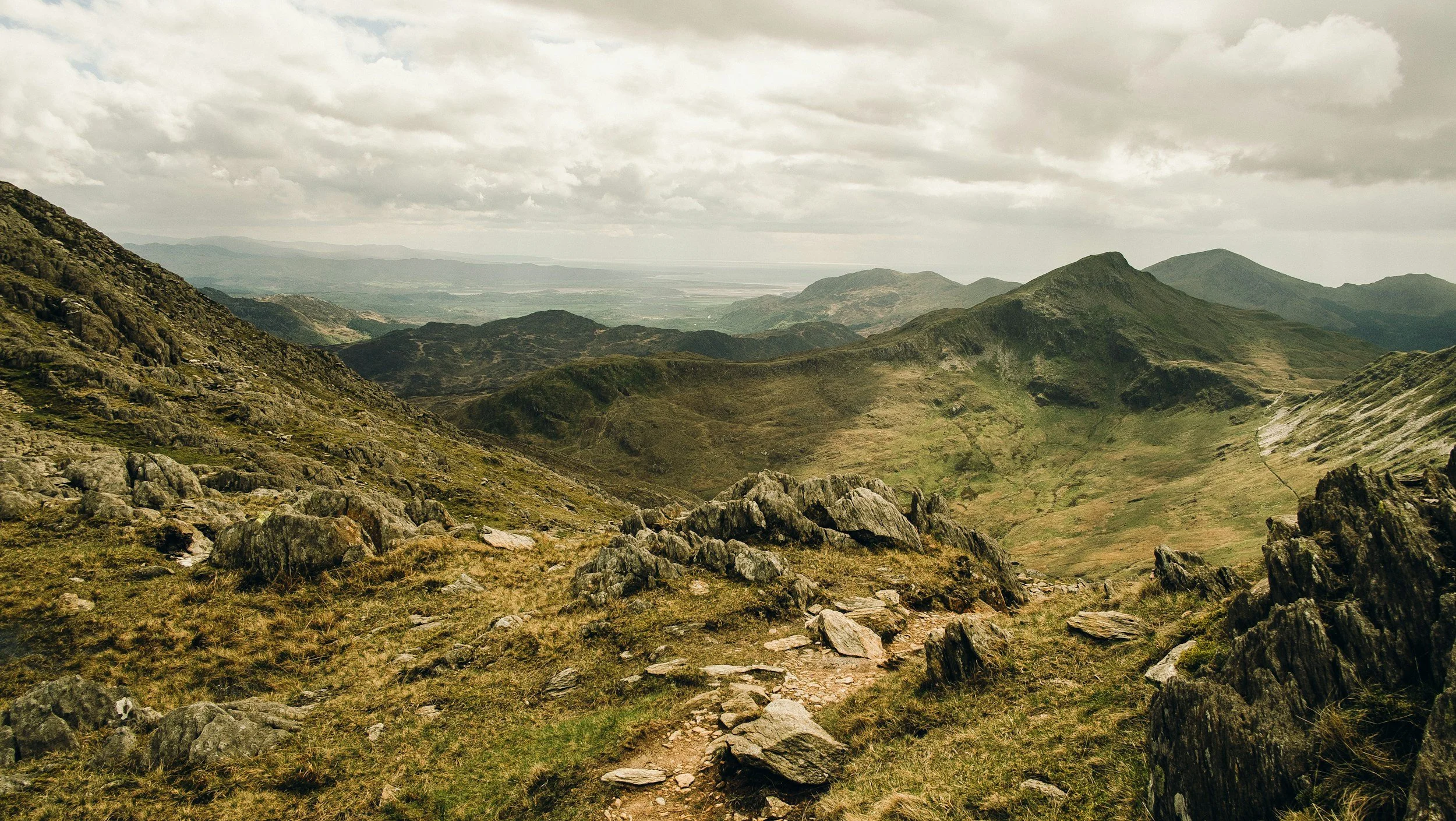
I spent a lot of time in Wales between the ages of 25 and 28, flying back and forth to visit my partner in his country. I worked remotely, so I was able to spend a few months at a time there, and over the years, it became a second home. In Wales, I awakened to a physical freedom I had never experienced in the stuffy suburbs of the Midwest. In Wales, I could walk out the front door and just keep walking (which I often did). There, I had the right to roam – literally and figuratively. I could veer off the footpaths, follow the sheep trods, and scrabble up lichen – covered boulders for a better view. Almost nothing felt “off limits” the way it does in the U.S.
It was in Wales that I was first introduced to the poet Gillian Clarke. Clarke was the national poet of Wales from 2008 to 2016. She was born in Cardiff but currently lives in Ceredigion. She has taught creative writing at the University of Glamorgan, and in 1990, she cofounded Tŷ Newydd, a writing center in North Wales. In her poetry, she evokes the magic of the Welsh landscape, the complexities of womanhood, and the inevitability of grief.
My partner didn’t read poetry, but his mother did, and during what would become my final visit, she lent me her copy of Letter from a Far Country, a collection of Clarke’s poems first published in 1982. I read it one morning while my partner was away, bundled in the cold sheets of his bed, upstairs in his 500-year-old cottage.
The titular poem, “Letter from a Far Country,” is an epic poem, 406 lines long. But unlike other epics, it is not about war or warriors. This epic is about a woman doing housework, dreaming of leaving, and ultimately deciding to stay.
Right away in the second stanza, the speaker offers an apologia – a defense – to the “husbands, fathers, forefathers,” for leaving. She describes how she has upheld her womanly duties honorably, without complaint, feeding and cleaning and preparing.
It has always been a matter
of lists. We have been counting,
folding, measuring, making,
tenderly laundering cloth
ever since we have been women.
I didn’t expect to feel so seen and so angry at the same time while reading this poem. I hadn’t noticed, possibly until that very moment, trying to keep warm under my partner’s blanket, how conflicted I really felt about what it means to be a woman.
Over time, my relationship with Wales had become complicated by my actual relationship. While I felt free in the vastness of the Welsh landscape, I also felt increasingly limited by the evolving responsibilities of my role as “woman-in-a-partnership.” There were days I felt confined to his cottage, resigned to the “womanly” duties of cooking and cleaning while he went off to work or away for the weekend. This frustration was compounded by the fact that in his country, socially speaking, he had a full life, but I really only had him.
I don’t know when exactly the question rooted itself in my chest, but I could feel it growing towards the end: I love this country, and I love this man, but do I love this life?
—
The speaker of Clarke’s poem longs for something beyond caretaking, beyond “counting, / folding, measuring, making, / tenderly laundering cloth;” she longs for something wilder, richer, and fuller. She assures her family she is leaving them with sufficient supplies and instructions for when she departs. She says that everything will be “in its proper place, / when I have gone.”
(In the airing cupboard you’ll see
a map, numbering and placing
every towel, every sheet.
I have charted all your needs.)
To chart people’s needs – that’s what most women are taught and trained to do. As children, we’re given dolls and pets and little siblings and told to keep them safe, keep them fed and watered and alive. It’s only natural that we’d take on that same role with our partners later in life. Keep him fed, keep him watered, keep him alive (in whatever way you must).
I was no exception. In one of my journal entries from my last trip to Wales, I wrote: “I make him dinner. I make myself dinner too, of course, but sometimes we like different things. Sometimes I make two dinners at once. I wait for him to come home. I keep the bread in the oven. I don’t turn the soup on until I hear his car. He says he’s not hungry right now. Oh. Okay. I am hungry, but I don’t say it. It’s okay. I can wait.”
It wasn’t like this every night, but the longer we were together, the more I felt backed into my “role” as a woman whose main objective was to chart the needs of my partner – to bend around him, his interests, his goals, his family, his schedule. It wasn’t that he asked this of me. It was more like an instinct. Something already woven into my DNA, simply activated by circumstance. Keep him fed, keep him watered, keep him alive.
Three years into our relationship, my time in Wales had become less about exploration and adventure and more about upholding the prescribed duties of my gender. My own grandmother, when we spoke on the phone, would ask me not about my work or my writing or even about Wales, but about what I was making him for dinner that night.
—
Halfway through the poem, the speaker recalls a rhyme from a children’s book as she dreams about leaving:
The minstrel boy to the war has gone.
But the girl stays. To mind things.
She must keep. And wait. And pass time.
In one way or another, many women are told that their duty is to stay. Often for their family, but also for their partners. I come from a long line of women who have stayed (my grandmother included). Women who have minded things and kept and passed time their whole lives, no matter the personal cost. Women who have defined themselves by their familial roles, who have measured their worth in housework. But unlike them, I had the privilege of distance.
When I’d return to the U.S. after a months – long stay with my partner, there was always a part of me that felt like Icould breathe again. While I had lost the freedom and the beauty of Wales, I had regained a sense of personal independence. Away from my partner, I no longer felt pressured to assume the role of a dutiful woman who cooks and cleans and keeps the house warm, patiently waiting for him to come home.
I knew I couldn’t stay in that cottage and mind things and keep and pass the time forever. I loved him, and I loved Wales, but after three years, I – like the speaker – was ready to move on. I wanted to start my life, not try to fit myself into his.
The women are leaving.
They are paying their taxes
and dues. Filling in their passports.
They are paying to Caesar
What is Caesar’s, to God what is God’s,
To Woman what is Man’s.
It broke his mother’s heart when I ended things. Over the years, she had become like my second mother to me, and I feel the most guilt for leaving her. Never in my life has someone so frequently asked if I needed anything, so persistently offered me food, so often bought me gifts. “I’m at your beck and call,” she’d say. And she was. Anytime I needed anything, she was there.
This past Christmas, the first one since our breakup, I received messages from my ex, his father, and his aunt, all wishing me a happy holiday. I did not hear anything from his mother, which to me felt like a well-deserved snub. She had given me everything, and then I had left her, without explanation. I did write her a letter after the fact, apologizing for the situation and expressing my wish that our paths might cross again. She responded eventually, but the letter was short.
She was another woman who stayed. After an unexpected pregnancy in her early twenties, she found herself suddenly tied to a man and a house and a family. While I didn’t know her then, of course, I could clearly see how these circumstances shaped her over time. When she wasn’t working, she was either cooking, offering to cook, cleaning, lamenting about the mess, bringing us firewood, doing her shopping, offering to do our shopping, helping her mother, groaning about her mother, asking if we needed anything, then cooking some more. Her only self-indulgent outlet was running. She’d run up mountains in the slicing rain, drive north for weekend races, push her body to the breaking point. And then the next morning, it was back to cooking, cleaning, shopping, helping.
I never asked if that’s the sort of future she wanted for me. I’m sure if I had, she would have said no. Unlike my grandmother, she supported my writing and encouraged me to pursue a creative career. I think that’s why she lent me Clarke’s book of poems. To show me that women can make art. That I could make art.
I wish someone had taken her aside when she was young and told her that she could make art too. That being a woman didn’t have to mean surrendering yourself to the ceaseless, thankless cycle of caring for everyone but yourself.
—
To help myself muster the courage to leave, I tried to think about the things I wouldn’t miss: I wouldn’t miss the damp, the perpetually dirty floor, the frigid sheets, the spiders, the mice, the constantly dwindling woodpile, the inability to drive, the never-feeling-clean feeling, the beam above the toilet in the bathroom, the holes in the walls. I wouldn’t miss the mood swings, the unwashed hands, the tools on the kitchen counter, the unsolicited advice.
This helped, but it didn’t compensate for the grief I felt in losing my connection to this beautiful place. I had never expected to fall in love with a Welshman. I never expected to fall out of love with him either. But the thing I expected the least was, that after the falling in and out of love, I’d be left with an intense longing for a country that was never mine. That even now, I’d still feel this thorny, tightly wound yearning for Wales, caught in my throat like a sob.
—
In the poem, the speaker never leaves. She spends much of the poem planning and preparing for her departure, dreaming about faraway and familiar places, but ultimately, she doesn’t go anywhere. She is called back to her duties, to her fate, not by the men, not by the children, but by the women who came before her.
I hear the dead grandmothers,
Mamgu from Ceredigion,
Nain from the North, all calling
their daughters down from the fields,
calling me in from the road.
They haul at the taut silk cords;
Set us fetching eggs, feeding hens,
mixing rage with the family bread,
lock us to the elbows in soap suds.
Their sculleries and kitchens fill
with steam, sweetness, goosefeathers.
She doesn’t sign the letter – the apologia – and she doesn’t send it. She says she will, when it is done, but we know she won’t. She will never be done. She’s needed at home.
The last three stanzas of the poem are a separate entity. They’re an italicized list of questions that ask who will do the women’s work if the women leave? “If we launch the boat and sail away / Who will rock the cradle? Who will stay? … If we adventure more than a day / Who will do the loving while we’re away?”
When I got to these final lines, still under the covers in my partner’s bed, I frowned in confusion. I thought this was a poem of escape, of agency, of chosen freedom and independence. Why was Clarke reeling us back to our washing machines and kitchen countertops after painting such a tempting vision of life beyond?
I am not the only person who has felt this way – other readers have expressed dissatisfaction with this ending, and Clarke has addressed the controversy, saying, “This separate ‘poem’ was written as a nursery rhyme, like something that plays in our heads whether we like it or not, a bit like ‘Stand by your man.’ It’s a song … and was written to be sung or hummed … like a subliminal message that’s hard to escape.” She has also said that “Letter from a Far Country” “began in frustration” but “continued as a poem praising women’s work.”
This is possibly why I felt both validated and betrayed by this poem. I understand the speaker’s desire to break free of the “feminine privilege” of serving, of escaping to that “far country” of freedom. But throughout the poem and especially in these final three stanzas, this “feminine privilege” is lauded, polished like a proud badge of honor. It seems to say that women are the only ones capable of doing this work, of charting people’s needs, of caretaking and housekeeping. Of loving.
I reject this sentiment. Women are not the only people capable of such work. And we should not be limited to demonstrating our love in only those ways.
I realize that Clarke wrote this poem in the 1980s, possibly before. And I recognize that what she calls “women’s work” is essential work, beautiful work, and it brings many people great joy and fulfillment. The issue I have is with the expectation that because we are women, we must also be these other things, and by extension cannot be anything else.
—
When I think about Wales now, I think about the mountains and the rain and the sheep. But I also think about his cottage. Made of limestone and slate, tucked into the side of a mountain, it has stood there since the sixteenth century and had at one time been a barn in which cows were kept. If you look up from the couch, you can see where the cows nibbled the wooden rafters however many decades, or maybe centuries, ago. During one of my visits, we painted the doors red, and during another we lime – washed the interior walls purple and yellow. In many ways, it was my cottage too. But in other ways, it wasn’t.
There’s a word in Welsh, hireath, which means, more or less, an intense longing or homesickness for a place you can never reach, whether it’s a place that doesn’t exist, or a place that doesn’t exist anymore. (Some people interpret hiraeth as a longing for a Wales that never was. A Wales that was never invaded by the British. A pristine, idyllic version of itself that was never allowed to be.) Wales obviously still exists, but now, for me, it only exists in memory.
In many ways, I don’t feel like I’m allowed to use this word. I’m not Welsh, and I’m no longer tied to anyone who is. But when it comes to how I feel about Wales now, I don’t know what other word to use.
Years ago, before things started to sour, he got me a framed print of the word hireath and mailed in to my house. I found it odd that he would choose such a sad word as a gift. But maybe he knew. Maybe he suspected that one day I would need this word to describe this ache in my stomach.
The word hiraeth is never used in “Letter from a Far Country,” but you could argue that the whole piece is imbued with the energy of the word. The woman in the poem longs to escape to this known/unknown/knowable/unknowable place far away from where she is. On her website, Clarke tells us that “The ‘far country’ is childhood, womanhood, Wales, the beautiful country where the warriors, kings and presidents don't live, the private place where we all grow up.” Places that once existed, but not in the way we now remember. Places that are no longer, and never really were.
Maybe that’s partly why the speaker stays. Not just because she’s needed at home, but because she knows she can’t actually escape to this magical past – future. Because it’s only accessible in her dreams.
I hope Wales is not limited to my dreams. I imagine I’ll go back one day and reintroduce myself to the wind, and the blackberries, and the mud. Hate the rain again, and watch the clouds roll over the mountain peaks like silent avalanches. Listen to the sheep’s incessant chatter and trudge through the bracken in the blistering sun and pick winberries on the hills until my fingers are purple.
No one will be there to pick me up at the airport, which is sad, but also okay. I’ll find my way back. I’ll stay in a different cottage in another tiny, quiet village. I’ll watch the swifts and smell the bluebells. I’ll find a door of my own to paint red, or maybe green. Then I’ll walk outside and just keep walking.
Kasey Kirchner is first-year MFA candidate at the University of Idaho, where she serves as the Marketing Editor for Fugue. Originally from Indiana, Kasey graduated from Butler University in 2019 with a degree in English before beginning her career in marketing. She writes about distant and alternate worlds.